|
|||||||


| Hard Bodies Diving minnows are the name of the game here… Attack, Halco, Oargee, Tilsan. Rebel… |

 |
|
|
Thread Tools |
Rating: 
|
Display Modes |
|
|||||||
| Hard Bodies Diving minnows are the name of the game here… Attack, Halco, Oargee, Tilsan. Rebel… |
|
|
|
Thread Tools |
Rating:
|
Display Modes |
|
#1
 07-02-2010, 03:18 AM
|
|||
|
|||
|
Colour Theory
Just now I learned a few things about colours and the way fish see them. In theory this should be a pretty good way to pick colours for lures. (This may also be common knowledge - I'm a beginner you see, lol)
"Direct light from the sun is called white light. It appears to have no color, however it is actually composed of all the colors in the spectrum. If you were to project it through a prism, you would see it break up into bands of color. Each color is a wavelength of light. When we go underwater, water absorbs the wavelengths of light one by one as you get deeper. " - some brosef / brosefette's blog 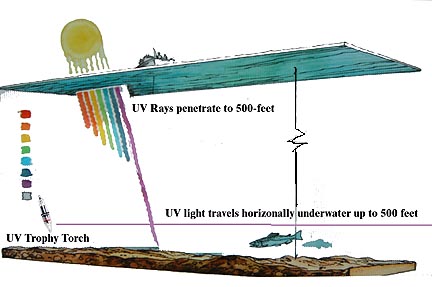 - from underwaterfishinglights (trying to sell us something, but still some nice info) Some kind of estimate " * Red will disappear at a depth of around 15 to 20 feet. * Orange at between 25 to 30 feet * Yellow at 45 to 60 feet * Green at 70 feet * at 100 feet, everything will appear blue or grayish green * at extreme depths all the light will be absorbed and everything will appear deep blue or black. " - some brosef / brosefette's blog To be unambiguous, the order of least visible to most visible colours as depth increases is: (first to fade to grey/black) Red, Orange, Yellow, Green, Blue, Indigo, Violet (last to fade as depth increases) Or the higher the frequency / [lower the wavelength] on the colour spectrum, the deeper that colour will penetrate. Simple Conclusion: On the ideal sunny day, choose a colour based on the depth of water you are fishing. Assuming your target species will only take a colour similar to what it's natural prey is, choose a natural colour! Discussion Topics Surface Lures When viewed with the sun as the background, any colour will look like a silhouette of grey/black. In theory any colour should suffice, maybe have shiny reflective types for shallow divers. Night Fishing Moonlight is just reflected sunlight hence has the same spectrum as sunlight but weaker. I would assume that moonlight doesn't have the intensity to show any colours underwater at night. So if all colours look grey/black, choose a black lure for the strongest silhouette. Transparent Lures I don't know what it is about transparent lures, they should be the most difficult to see, but somehow I get the most aggressive strikes on them. Since the plastic used probably doesn't have the same refractive index as water, they'll look like a silhouette of the background colours. Could it be that these clear shrimps, whitebait and squid are the tastiest of all? like the foie gras of the ocean?! When should you choose transparent? I guess if you can see clear bait jumping or if your target eats squid Dirty Water & Cloudy Days Light will be interrupted by the tiny floating debris / clouds, hence colours will penetrate much less. Fish Vision Different fish may have different levels of vision. It could be possible to guess by how big their eyes are with respect to their head size. This will remain an unknown variable for most of us though Holo / Chrome / Reflective Lures For bait fish lures this should be good. Working best on a sunny day Other Senses Fish sense their prey via sight, smell, hearing and vibration (through their lateral line). Ideally if a lure appeals to all of these it should be a winner. Extended Conclusion: Under non-ideal / real world conditions factors that may matter more than colour for lures: - Size - Shape - Action - Smell - Audio (if rattles really help i don't really know) The power of live bait is now clearer than ever in my mind. It is the right colour, shape and size, swims like the real thing, is probably bleeding a bit and is calling for help. I once thought lures could match bait, but now that I think about it, probably not live bait. Credits and further reading: deep-six diving article bigfishtackle article - a really terribly formatted site, the text is repeated multiple times in different places. but probably the most scientifically thought out article i referred to saltwater sportsman article some nice colour spectrum pics (including moonlight) - by Jerry Xiaojin Zhu also thanks nereus for alerting me to this topic Last edited by ssymmetri; 07-02-2010 at 03:27 AM. 
|
|
#3
07-02-2010, 06:23 AM
|
|||
|
|||
|
great article ssmmetri,
just to add i found a book in a tassie tackle shop "what fish see" by colin kageyama who is a optometrist in the usa. a good read with lots of pictures of lures and different colours at different depths. very interesting. cheers mike.
|
|
#4
07-02-2010, 06:57 AM
|
||||
|
||||
|
Night Fishing
Moonlight is just reflected sunlight hence has the same spectrum as sunlight but weaker. I would assume that moonlight doesn't have the intensity to show any colours underwater at night. So if all colours look grey/black, choose a black lure for the strongest silhouette. To the above you posted up, i catch fish in strong moonlight on bright light coloured lures all the time.  Chop
__________________
Hardbody PB - 48cm Onk model-Zipbaits khamsin #300 - 48cm from Blackdogs-Zipbaits orbit slider #032 - 101cm Mulloway on Zipbaits khamsin #798  Soft plastic PB- 46cm Kangaroo island model- Gulp sandworm .
|
|
#5
07-02-2010, 08:03 AM
|
||||
|
||||
|
jeez you don't do things by halves fella,good topic.
cheers nereus
__________________
H/B 45cm and keeping at it S/P 53cm should do more really  vibe 45cm i'm liking em Surface 39cm and work in progress H/B mully 83cm and not so bitter S/P mully 85cm on 4lb FC
|
|
#6
07-02-2010, 09:58 AM
|
|||
|
|||
|
Quote:
|
|
#7
07-02-2010, 10:04 AM
|
||||
|
||||
|
In my experience, action has more attracting capability's than colour when fishing at night.
Chop
__________________
Hardbody PB - 48cm Onk model-Zipbaits khamsin #300 - 48cm from Blackdogs-Zipbaits orbit slider #032 - 101cm Mulloway on Zipbaits khamsin #798 Soft plastic PB- 46cm Kangaroo island model- Gulp sandworm .
|
|
#8
07-02-2010, 09:53 PM
|
||||
|
||||
|
I don't know what it is about transparent lures, they should be the most difficult to see, but somehow I get the most aggressive strikes on them. Since the plastic used probably doesn't have the same refractive index as water, they'll look like a silhouette of the background colours.
Translucent lures actually refract light. This means they pretty much glow as light is captured. For predator fish this is a dead give away for many species that spend much of their time trying to be invisible. In a predator fishes eyes the refraction is what they look for when a fish is trying to blend in. The great thing about translucency is like the baitfish that want to blend in; the amount of light will alter the lures colour according to light intensity, water colour and light availability according to depth. When you look at many bait-fish, prawns, shrimp etc, they are trying to achieve the same thing. Some organisms like shrimp take on the tannin they inhabit which probably drops refraction further and blends them with their current surroundings. If your colour is static in shallower water you are dead meat. When fish like whitebait, whiting, bonefish etc turn on their side facing the sun they flash. When the sun sits lower they become more evident to their predators "in" the water. Its probably why many lures have gone down this path to some extent to attract some fickle fish like the Dichromats that visually may well be more focused on this sort of attribute which defines something as alive rather than dead matter. If a Bream can pick up a free floating black pearl mussel at 30 feet in fast current which provides no vibration, no sound definitely though a complete contrast with a shiny pink ,turquoise light refraction and chases it that sight is an important part of its hunting tactic's? The issue is we relate light penetration based on the human sight model. Fish see into both ends of the spectrum deeper depending on the fish and use it to their advantage. That's their edge on hunting as a particular species. Low refraction is probably why in shallower clear water on older pressured fish that carbon lines provide that extra little difference in camouflage.
|
|
#9
07-02-2010, 10:03 PM
|
||||
|
||||
|
The issue is we relate light penetration based on the human sight model. Fish see into both ends of the spectrum deeper depending on the fish and use it to their advantage. That's their edge on hunting as a particular species.
Possibly some of the give away is for instance Dhufish or Jewfish, same same are a UV purple colour. Is it that they utilise this spectrum frequency to see in low light even when the moon is bright? The UV from the moon in its bandwidth makes it to the bottom? That this frequency in the spectrum is their communiqué? That potentially in spawning they can to some extent see each other? That potentially this frequency is their low light vision choice at depth? Wideband MOFO's?
|
|
|
|


 Linear Mode

